
Inside a Furniture Factory Vietnam: What Truly Makes It Stand Out
A modern furniture factory Vietnam is far more than just a basic processing workshop. Behind every batch of furniture exported worldwide lies an extensive system of advanced machinery, skilled labor, and strict quality control processes. At Aurora Craft, we invite businesses to take a closer, authentic look inside a Vietnamese furniture factory – to see why Vietnam’s furniture industry keeps earning its place on the global map.
What Makes a Furniture Factory Truly Stand Out?
Walking inside a furniture factory in Vietnam today reveals far more than rows of machinery and production lines. What truly separates a high-performing manufacturer from the rest is the ability to combine craftsmanship, production efficiency, material expertise, and global manufacturing standards into one seamless operation.
Behind every finished product is a complex system of people, processes, and technical capabilities working together to ensure consistency, scalability, and quality at every stage of production.
Skilled Craftsmanship Behind Every Production Line
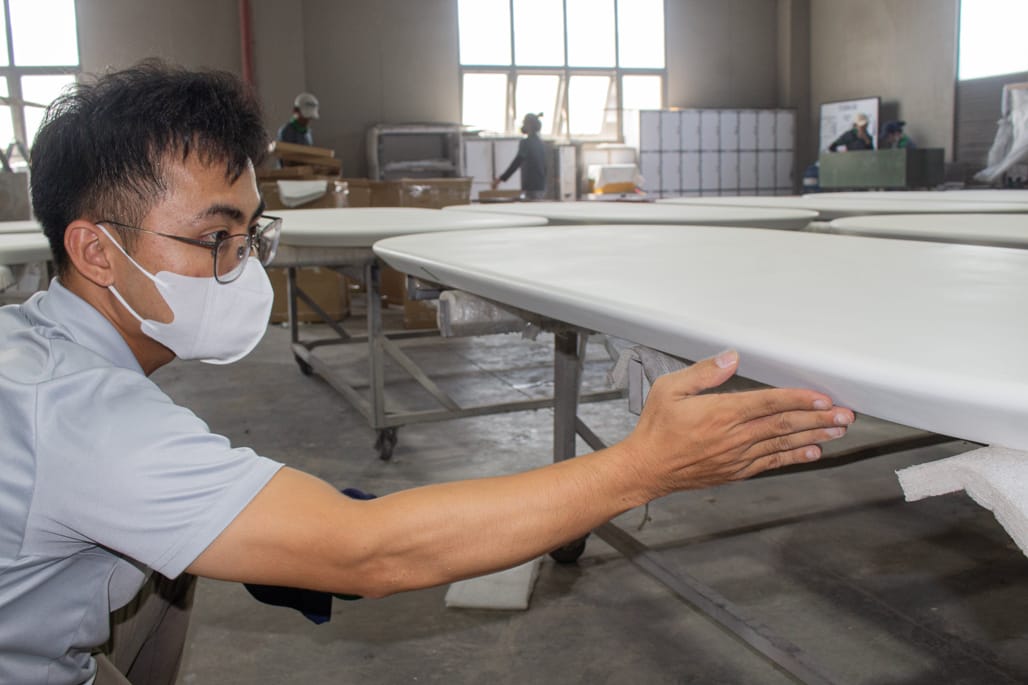
Even with advanced machinery, craftsmanship remains a critical part of furniture manufacturing. Inside a professional furniture factory Vietnam operation, experienced workers are still essential for assembly, sanding, upholstery, joinery, surface finishing, and detailed quality inspection.
Export production requires more than visual quality alone. International buyers expect consistency across large production volumes, which means factors such as edge finishing, upholstery alignment, color matching, and structural accuracy must remain uniform from the first unit to the final shipment.
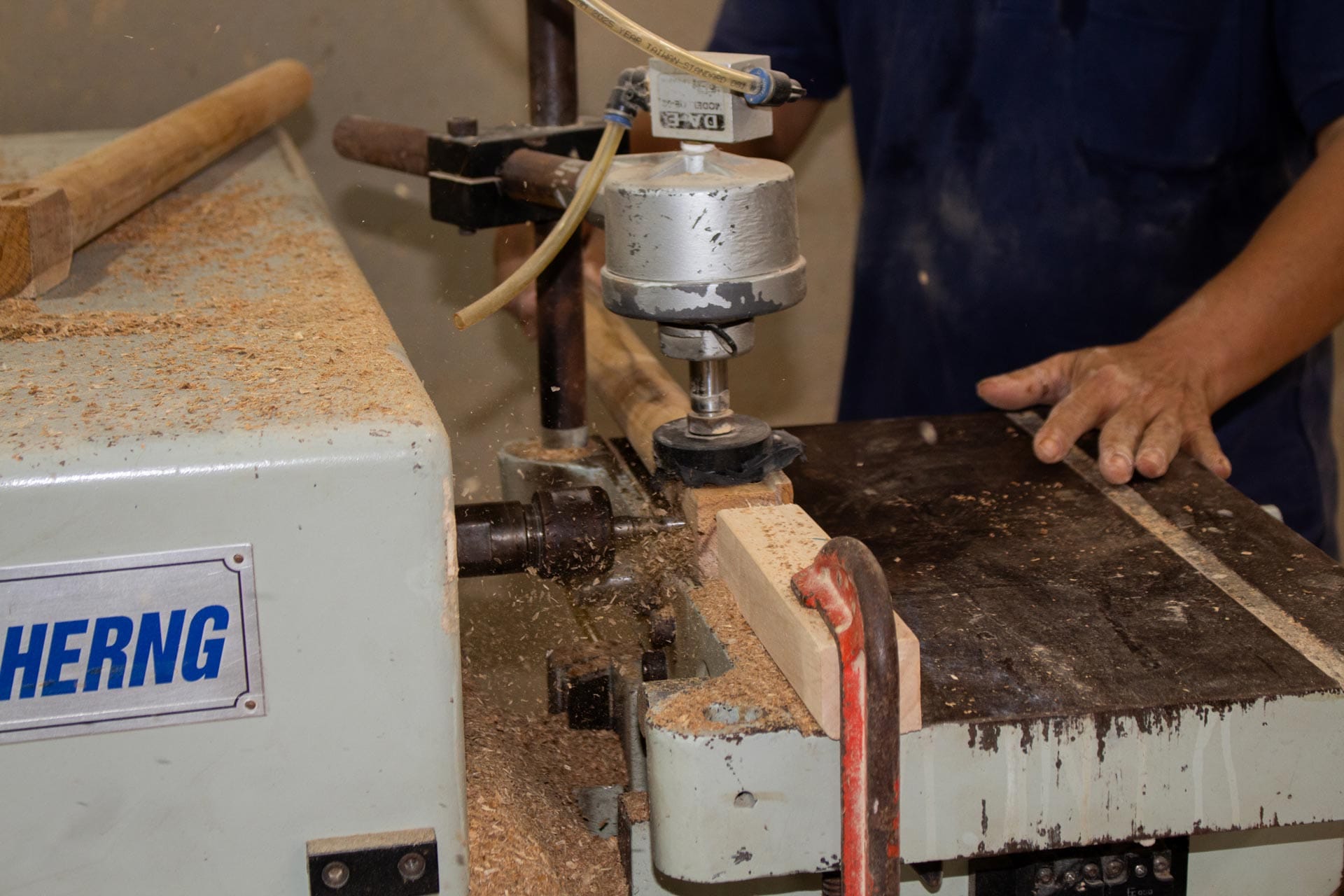
This combination of skilled labor, production discipline, and manufacturing experience is one of the reasons Vietnam continues to strengthen its position as a trusted global furniture manufacturing hub.
Advanced Manufacturing Infrastructure
Modern furniture factories rely on more than labor alone. Strong manufacturing infrastructure forms the foundation for maintaining production accuracy, stable quality, and long-term manufacturing reliability.
Inside a professional furniture factory Vietnam operation, CNC machines, automated cutting systems, edge banding equipment, drilling machines, and sanding lines are used to improve machining precision and reduce production inconsistencies across large order volumes.
Well-equipped factories are also better prepared to handle different furniture categories, material requirements, and technical specifications while maintaining consistent production standards. This manufacturing capability foundation is especially important for export-oriented projects where precision, repeatability, and finishing quality directly impact buyer expectations.
Material Expertise and Production Flexibility
A professional furniture factory Vietnam manufacturer must be able to work with a wide range of materials while maintaining consistent production quality.
Many factories in Vietnam work with engineered wood materials, solid wood, GFRC, metal, veneer finishes, and upholstery materials, each requiring different machining, finishing, and quality control processes. Different furniture categories and export markets also demand different production workflows, material combinations, and finishing standards.
Material selection also plays a major role in determining outdoor furniture durability, maintenance requirements, and long-term product performance. Different wood species offer very different levels of moisture resistance, weather durability, and structural stability depending on the target market and usage environment.
To better understand which materials perform best in outdoor applications, explore our guide to choosing the right wood for outdoor furniture.

This production flexibility allows manufacturers to support hospitality projects, retail collections, and custom commercial furniture efficiently while maintaining scalability and consistent quality across large orders.
Quality Control at Every Stage
Quality control is not limited to final inspections at the end of production. In professional furniture manufacturing environments, quality management is integrated throughout the entire workflow.
This includes material inspection before production begins, inline checks during assembly, finishing inspections, hardware testing, and final packaging reviews before shipment. Early defect detection helps reduce production errors, improve consistency, and prevent delays later in the process.
Packaging quality is also an essential part of quality control, especially for export markets where products must withstand long-distance transportation and international handling conditions.
Export Readiness for Global Markets
Furniture manufacturing for international markets requires much more than production capability alone. Export readiness is another key factor that distinguishes experienced factories from smaller local operations.
Factories serving global buyers must understand packaging standards, container loading optimization, shipping coordination, export documentation, and delivery timeline management. Products also need proper moisture protection, secure packaging systems, and handling preparation to reduce damage risks during long-distance transportation.
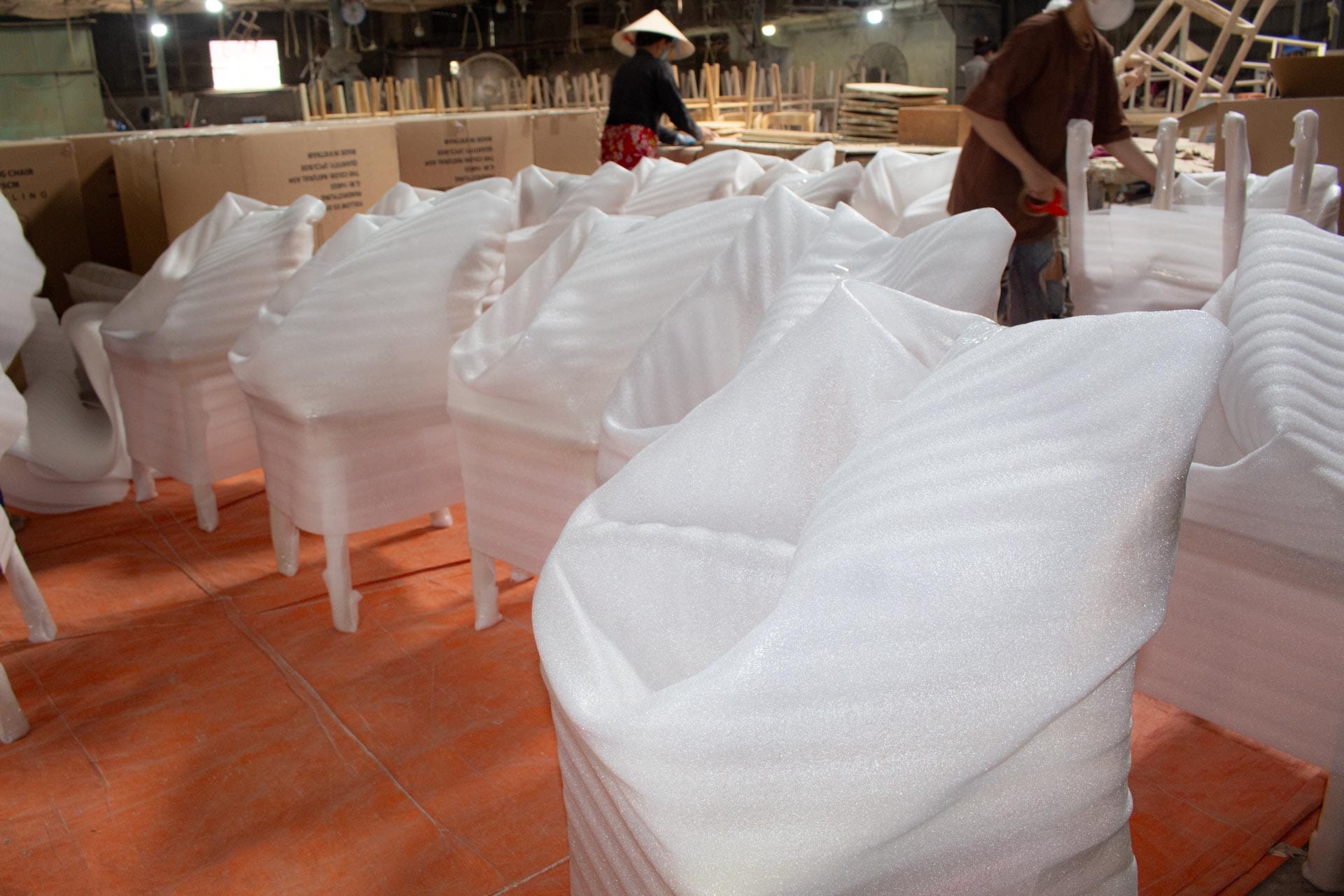
This operational readiness allows a professional furniture factory Vietnam manufacturer to support retailers, hospitality brands, wholesalers, and commercial projects across multiple global markets while maintaining stable supply chain performance and delivery reliability.
An Overview of Vietnam’s Furniture Industry
Looking back over recent years, Vietnam’s furniture industry has been entering a period of remarkable growth. According to Mordor Intelligence, the market size has reached USD 9.62 billion by 2025 and is projected to grow to USD 13.14 billion by 2030.
Yet this export value is just one part of the bigger picture. The real momentum comes from free trade agreements like the EVFTA and RCEP, along with tax incentives that benefit export-oriented manufacturers.
In addition, Vietnam’s competitive labor costs and the increasingly refined craftsmanship of Vietnamese workers have become key advantages. The combination of these factors continues to strengthen the country’s position in the global furniture export market.
Overall, this promising outlook opens up valuable opportunities for any furniture factory Vietnam — especially those with long-term investment capacity, a commitment to technological innovation, and the vision to lead sustainable material trends in the industry.
Scale and Infrastructure of a Furniture Factory Vietnam meet quality standards
In the next section, join Aurora Craft on a behind-the-scenes tour inside a professional furniture factory Vietnam — where you’ll discover clearly defined functional zones and a smart, streamlined production line.
Functional Zones of the Furniture Factory
Inside a professional furniture workshop, production is typically organized into several key functional zones, each designed to streamline workflow and maintain consistent quality:
- Material preparation area: Where raw materials — whether solid wood, engineered panels, GFRC, or metal components — are carefully inspected, processed, and prepared according to project specifications.
- Shaping & surface processing area: Materials are cut, molded, milled, or sanded using specialized machinery to achieve precise dimensions and surface quality.
- Assembly & detailing area: Components are joined, reinforced, and fine-tuned to ensure structural integrity and accurate alignment for the final product.
- Finishing & quality control area: Products receive surface treatments such as coating, polishing, or texturing (depending on material) before passing through multiple QC checks to ensure durability and visual consistency.
- Packing & logistics area: Finished items are securely packaged, labeled, and organized for storage or container loading — ready for shipment to global destinations.

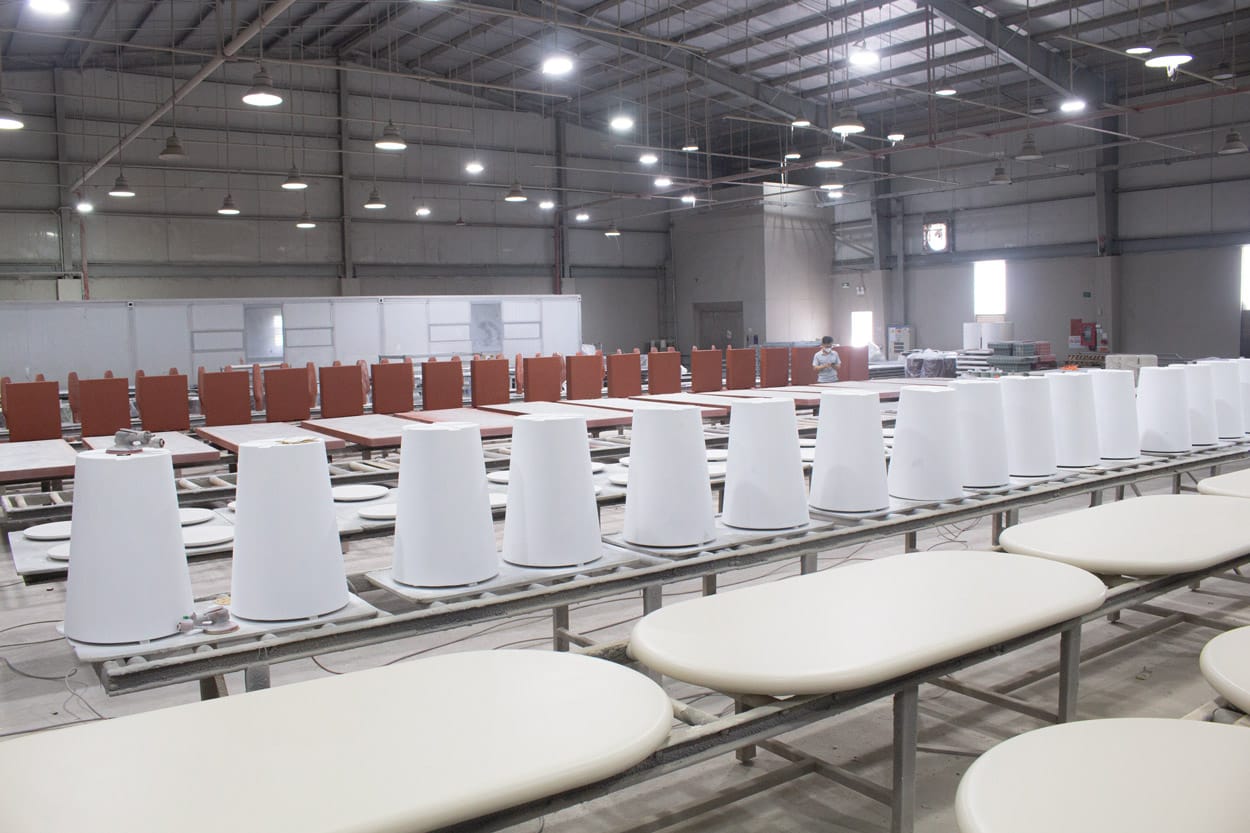
At Aurora Craft, we operate a furniture workshop spanning 10,000 m², with a production capacity of up to 60 containers per month. Our facilities are divided into multiple specialized sections, working in sync to keep production and delivery timelines firmly on track. This streamlined process ensures that international partners with high-volume orders can trust us to deliver reliably, every time.
Infrastructure Equipped at the Factory
In the past, furniture factories in Vietnam were often seen as disadvantaged due to limited investment in machinery. But that landscape has changed significantly. Today, many furniture factory Vietnam operations are equipped with production lines that meet international standards — enabling faster lead times and greater design flexibility.
At Aurora Craft, we fully understand the demands of scalable growth. That’s why, for years, we have consistently invested in modern manufacturing equipment across our production zones, including:
- CNC machines: Programmed for high-precision cutting and milling of complex components, ensuring superior consistency across batches.
- Router machines: Offer greater flexibility in shaping, edge profiling, and working with various materials tailored to custom design requirements.
- High-capacity sanding machines: Deliver smooth and even surface finishing at scale, preparing materials for flawless coating.
- Automatic edge-banding line: Speeds up the edge-finishing process while producing seamless, durable edges.
- Closed-loop spray coating line: Minimizes dust contamination during the painting process, resulting in smooth, uniform finishes.
- Specialized hydro-dipping tank for Travertine effect: A water transfer printing technique that creates natural-looking Travertine stone patterns on surfaces, enhancing the aesthetic appeal of premium product lines.

By tightly controlling production workflows and standardizing semi-automated processes, the Aurora Craft factory significantly shortens production time while minimizing manual errors. This enables us to handle large-volume orders with high technical specifications efficiently. Such stability and reliability have made Aurora Craft a trusted partner for global businesses across Europe, the U.S., and Australia.
How Large Furniture Factories Scale Production for Global Markets
A professional furniture factory Vietnam manufacturer must be able to scale production efficiently while maintaining stable quality, lead times, and export performance. This requires coordinated production planning, material sourcing, workforce management, and logistics systems capable of supporting fluctuating global demand.
Flexible Production Lines for Different Furniture Categories
A modern furniture factory Vietnam operation must be able to manage mixed-material products, hospitality programs, export collections, and custom commercial furniture within the same production environment.
To support this level of flexibility, factories organize production lines based on material requirements, finishing systems, and manufacturing workflows. CNC machining, assembly, upholstery, and finishing departments must work together efficiently to reduce downtime and maintain stable production flow across different project types.
Flexible manufacturing systems allow factories to adapt quickly to changing buyer requirements while maintaining operational consistency across large production volumes.
From Small Batch Orders to Large-Volume Manufacturing
International buyers often require different production scales depending on their business model, from small-batch custom furniture to large-volume retail and hospitality orders.
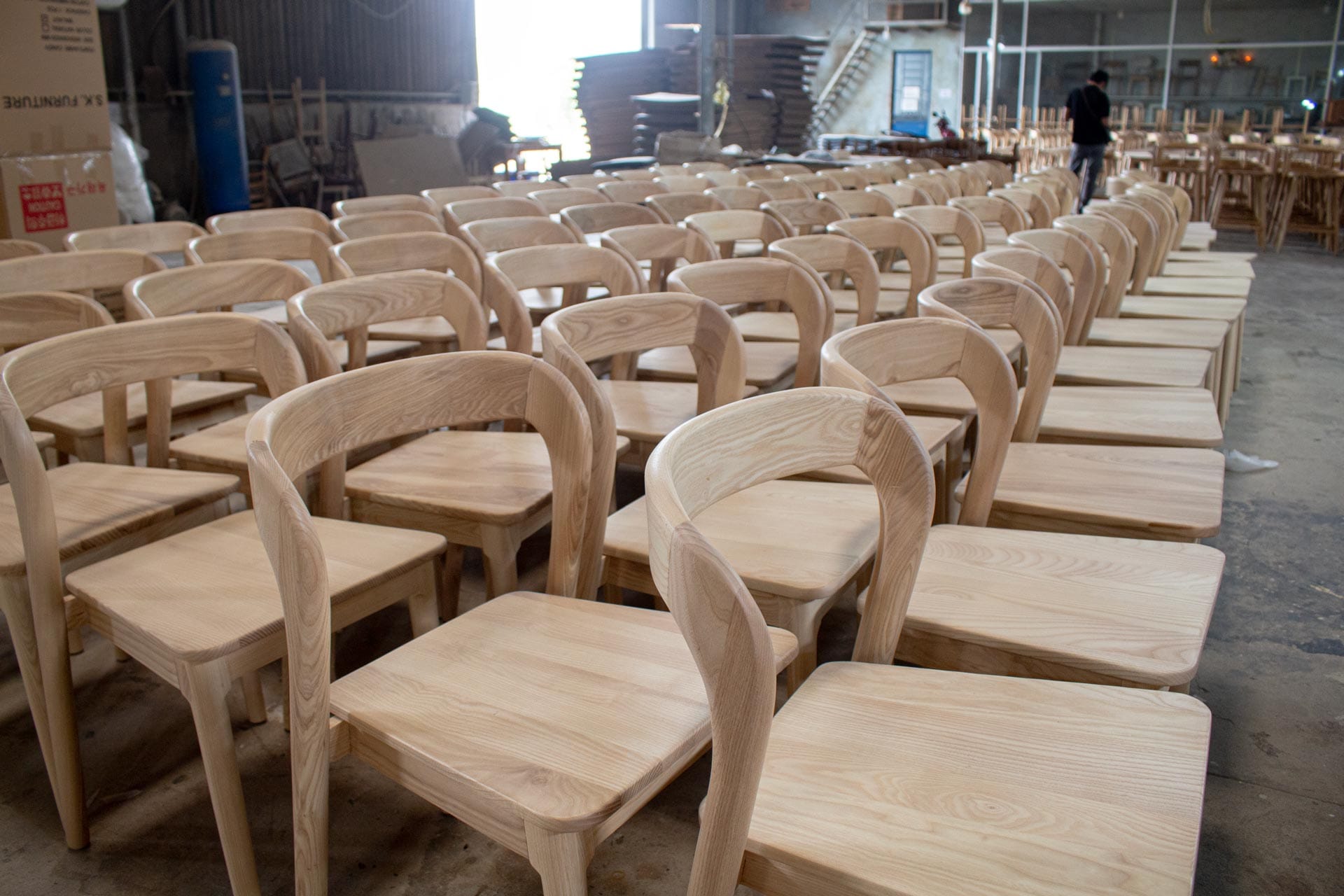
An experienced furniture factory Vietnam manufacturer must be able to manage both efficiently through scalable workflows, organized production scheduling, and flexible labor allocation. Maintaining stable output at different order volumes also requires effective line balancing, production sequencing, supplier coordination, and shift planning throughout the manufacturing process.
Managing Seasonal Demand and Global Supply Chain Pressure
Furniture manufacturing is heavily affected by seasonal demand, shipping schedules, and material availability. Large export-focused factories must continuously balance production capacity with supply chain coordination to prevent delays and maintain stable lead times.
Inside a professional furniture factory Vietnam operation, production teams closely manage raw material inventory, supplier lead times, workforce allocation, production scheduling, and container booking plans throughout the manufacturing cycle. Strong coordination between sourcing, production, packaging, and logistics departments is essential for maintaining stable operations during peak demand periods.
Coordinating Production for Multiple International Markets
Many export-focused factories in Vietnam simultaneously manufacture furniture for buyers across North America, Europe, Australia, and Asia. Each market may have different product specifications, packaging requirements, safety standards, and shipping timelines.
A capable furniture factory Vietnam manufacturer must therefore maintain strong internal coordination between engineering, production, quality control, and export teams. Clear communication and standardized workflows help ensure that products meet the technical and quality expectations of different international markets.
This ability to coordinate large-scale production across multiple global regions is one of the reasons why Vietnam continues to strengthen its position as a leading furniture manufacturing hub worldwide.
Inside the Furniture Manufacturing Process: From Concept to Export
Modern furniture manufacturing involves far more than assembly alone. A professional furniture factory Vietnam manufacturer must coordinate product development, material preparation, production planning, quality control, and export operations within a highly organized workflow.
Each stage of the manufacturing process directly impacts production efficiency, product consistency, lead times, and final export quality for international buyers.
Design and Technical Development
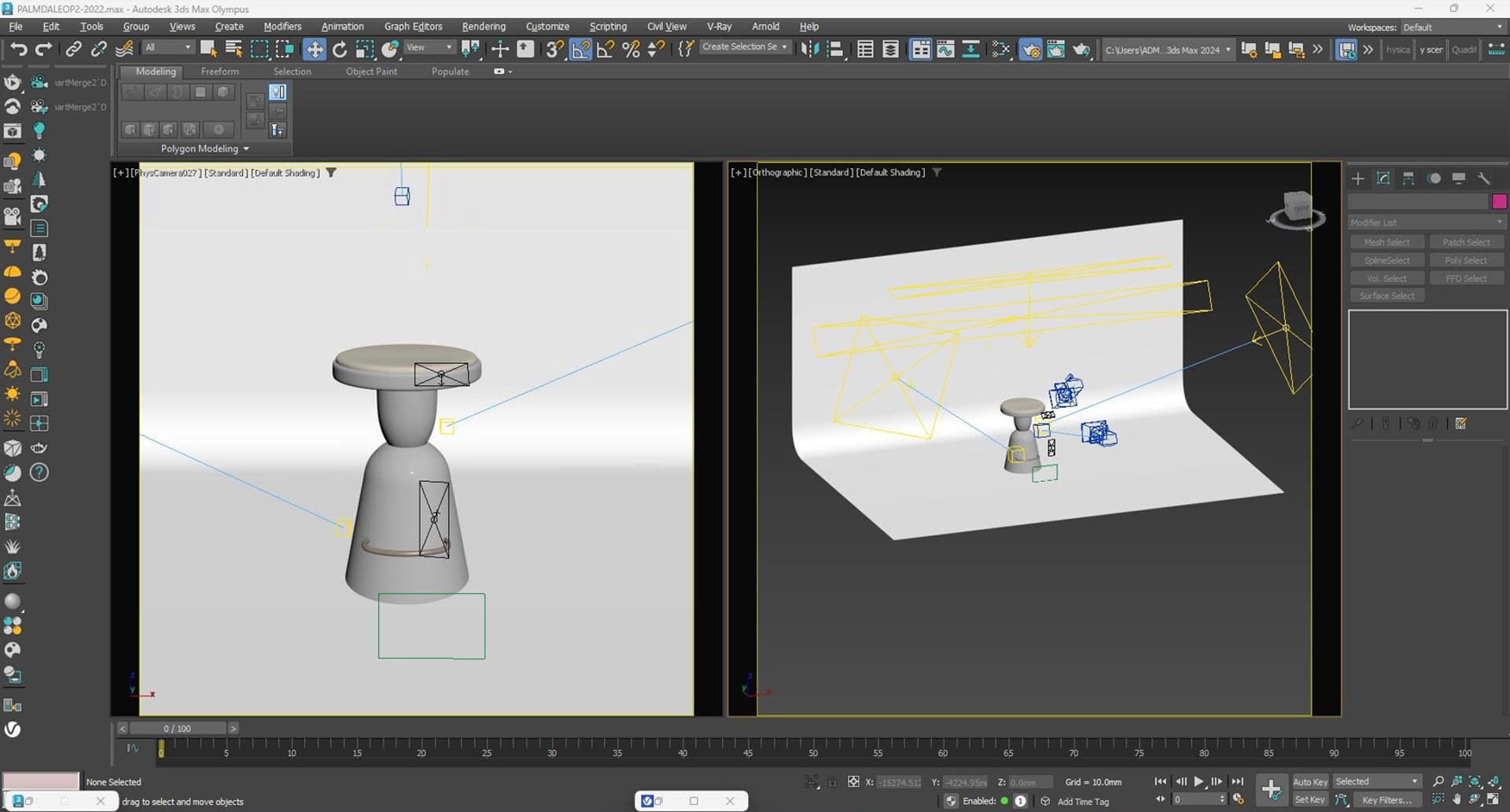
Every furniture project begins with technical planning and product development. Inside a professional furniture factory Vietnam operation, design teams work closely with engineers and production managers to ensure that concepts can be manufactured efficiently at scale.
This stage often includes CAD drawings, technical specifications, material selection, dimension verification, and construction planning. For OEM manufacturing projects, factories follow detailed buyer-provided specifications, while ODM projects may involve additional in-house product development support.
Strong technical development helps reduce production errors later in the manufacturing process while improving consistency across large-volume orders.
Material Selection and Preparation
Material preparation plays a critical role in product durability, finishing quality, and long-term manufacturing consistency.
Inside a professional furniture factory Vietnam operation, manufacturers work with engineered wood, solid wood, and mixed-material components depending on project requirements. Before production begins, materials are inspected for moisture levels, surface quality, dimensional consistency, and structural stability.
Once approved, materials move through cutting, shaping, and preparation processes using CNC machinery and precision manufacturing equipment to maintain stable production quality and reduce material waste.
Sampling and Prototype Production
Before mass production begins, factories typically develop samples or prototypes for buyer approval. This stage allows manufacturers to test dimensions, finishes, materials, construction methods, and overall product appearance before scaling production.
Inside an export-focused furniture factory Vietnam environment, prototype development is especially important for custom furniture collections, hospitality projects, and private label programs where design accuracy and finishing consistency are critical.
Sampling also helps identify potential production challenges early, allowing factories to refine workflows and improve manufacturing efficiency before entering full-scale production.
Mass Production Workflow
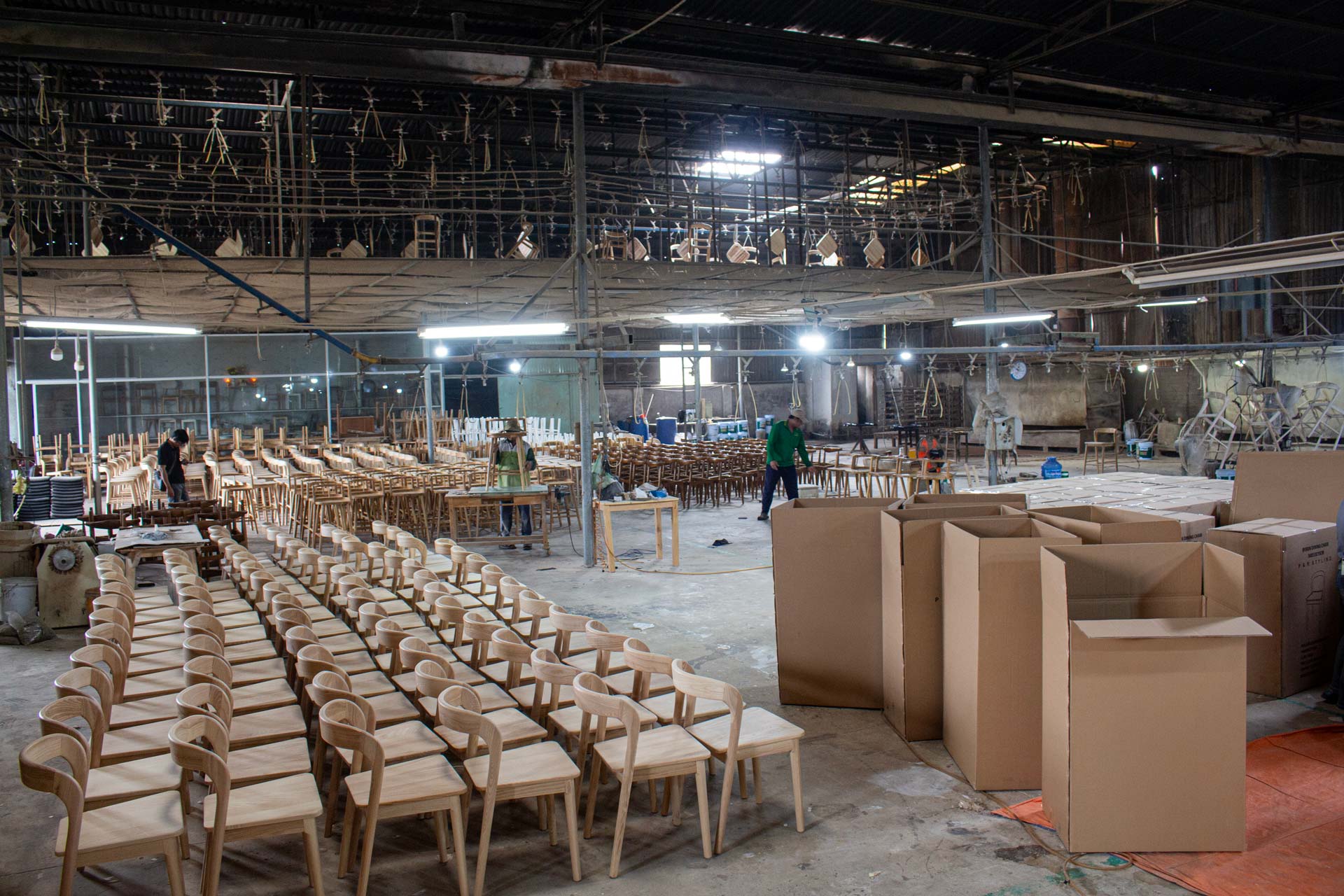
Once samples are approved, production moves into large-scale manufacturing. Inside a professional furniture factory Vietnam operation, multiple departments must work together through coordinated production workflows to maintain stable throughput, consistent quality, and reliable delivery timelines.
Modern factories combine automated machinery, workflow standardization, line management, and skilled craftsmanship to keep production moving efficiently across different product categories and order volumes. Strong production scheduling and process coordination are especially important for maintaining batch consistency and large-scale export performance.

Quality Inspection and Finishing Control
Quality control continues throughout the entire production cycle rather than being limited to final inspections alone. Inline inspections help detect defects early, reducing costly production errors and maintaining product consistency.
Inside many export-oriented factories, dedicated QC teams inspect dimensions, structural integrity, finishing quality, hardware installation, and packaging standards before products are approved for shipment.
Finishing control is particularly important because surface quality, color consistency, and detailed craftsmanship heavily influence how buyers evaluate furniture products in international markets.
Packaging and Export Preparation
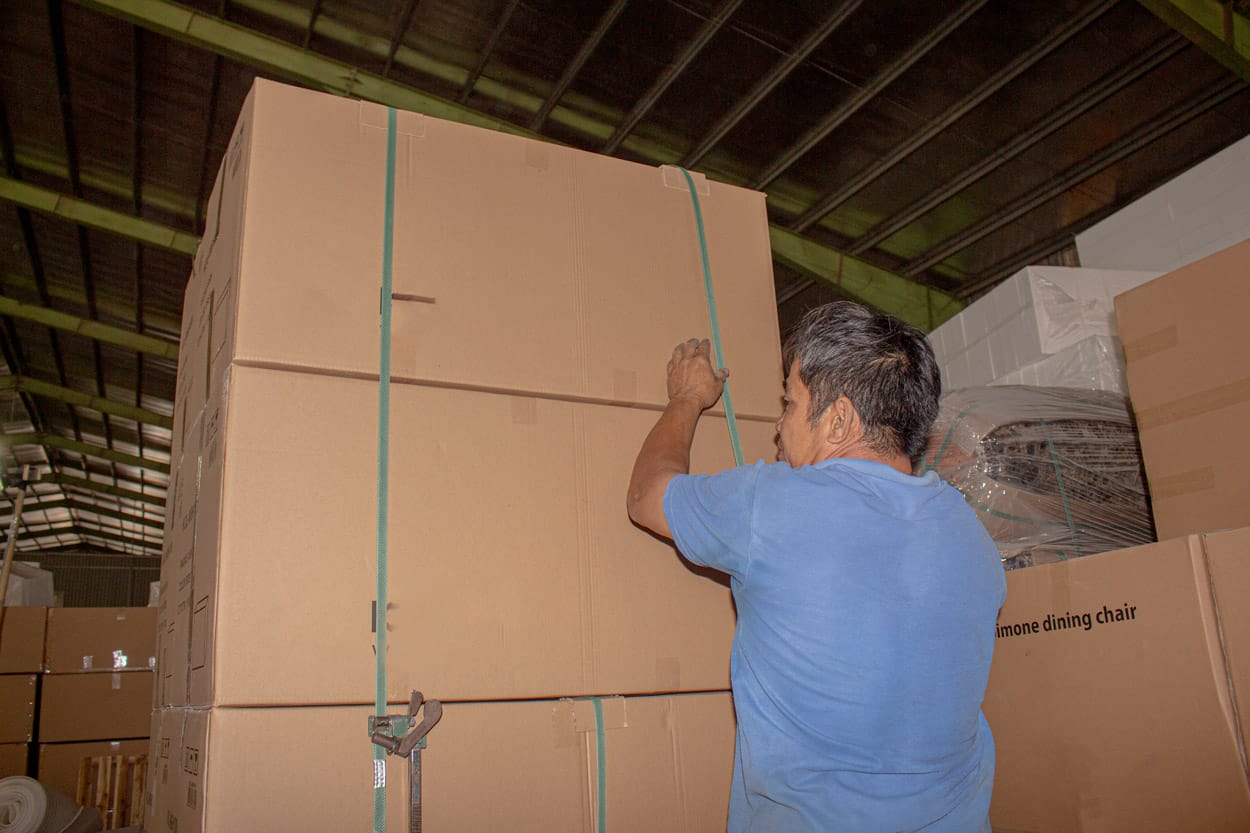
The final stage inside a furniture factory Vietnam production workflow involves packaging, export preparation, and shipping coordination. Products must be protected carefully against moisture, impact damage, and long-distance transportation risks before leaving the factory.
Export-focused manufacturers also manage carton reinforcement, foam protection, export palletization, mixed container loading, labeling requirements, and shipping documentation to maintain product safety and delivery accuracy across international markets.
Strong coordination between production, packaging, and logistics teams helps ensure products are shipped on schedule while maintaining consistent export quality and supply chain reliability.
How Furniture Factories Work with Different Materials
| Material | Common Applications | Manufacturing Advantages | Production Considerations |
| MDF & Engineered Wood | Cabinets, shelving, hospitality furniture, modern residential collections | Smooth finishing surface, cost efficiency, scalable production, precision CNC machining | Requires moisture control, edge sealing, and consistent lamination or painting processes |
| Solid Wood | Premium residential furniture, custom projects, hospitality collections | Natural aesthetics, durability, handcrafted appeal | Requires skilled craftsmanship, moisture management, and detailed finishing control |
| Veneers & Surface Finishes | Decorative furniture surfaces, luxury finishes, modern commercial furniture | Design flexibility, material optimization, consistent appearance | Precision bonding, sanding, color matching, and finishing consistency are critical |
| GFRC | Tabletops, outdoor furniture, hospitality and commercial interiors | Lightweight compared to traditional concrete, strong structural performance, modern architectural appearance | Requires specialized molding, curing, reinforcement distribution, and surface finishing expertise |
| Mixed Material Combinations | Wood-metal furniture, upholstered collections, commercial furniture systems | Enhanced functionality, modern aesthetics, flexible product design | Requires coordination across multiple production departments and assembly processes |

Modern furniture production increasingly relies on combining multiple materials within a single collection. Inside a professional furniture factory Vietnam operation, the ability to coordinate different manufacturing methods, finishing techniques, and quality control standards is essential for maintaining both scalability and product consistency across global markets.
How Vietnamese Furniture Factories Support OEM and ODM Production
A professional furniture factory Vietnam manufacturer must be able to support both OEM and ODM production models for international buyers. This requires coordinated product development, engineering, sourcing, production planning, and quality control systems capable of handling different levels of customization and scalable manufacturing.
OEM Manufacturing for Established Brands
In OEM manufacturing, factories produce furniture based on buyer-provided specifications, technical drawings, and material requirements.
A professional furniture factory Vietnam manufacturer must be able to manage BOM validation, material sourcing coordination, finish matching, sample approval workflows, and standardized production systems while maintaining consistent quality across large-volume orders.
ODM Capabilities for Faster Product Development
In ODM manufacturing, factories support product development through design adaptation, material recommendations, prototyping, and manufacturing optimization before production begins.
An experienced furniture factory Vietnam manufacturer must be able to coordinate engineering, sampling, and production workflows efficiently to help buyers accelerate product development while maintaining scalable manufacturing and consistent product quality.
Why Production Flexibility Matters
Modern furniture manufacturing requires flexible production systems capable of supporting different levels of customization, order volumes, and project requirements.
A professional furniture factory Vietnam manufacturer must be able to manage mixed SKU production, finish variations, multi-material adaptation, custom packaging requirements, and project-specific workflows across different furniture categories and export markets.
This operational flexibility allows factories to support retail collections, hospitality projects, commercial interiors, and private label programs more efficiently while maintaining stable production quality and delivery performance.
What International Buyers Look for Inside a Furniture Factory
International buyers typically evaluate furniture factories based on production consistency, operational reliability, communication efficiency, material expertise, and export capability. Inside a professional furniture factory Vietnam operation, these factors directly influence long-term manufacturing performance, supply chain stability, and sourcing reliability for global markets.
Consistent Product Quality Across Production Runs
One of the first things buyers evaluate inside a furniture factory Vietnam operation is production consistency. Large-scale furniture manufacturing requires every unit to match approved samples in terms of dimensional accuracy, finish matching, construction quality, and overall appearance.
Reliable product quality depends on skilled labor, accurate machinery, organized workflows, and strong quality control systems throughout the production cycle. Inline inspections, finishing checks, and final product evaluations help maintain batch consistency while reducing production defects across large-volume orders.
Reliable Production Capacity and Lead Time Management
Production capacity alone is not enough if a factory cannot maintain stable furniture manufacturing lead times and organized manufacturing schedules. Buyers often evaluate how efficiently factories manage production scheduling, throughput management, supplier lead times, labor allocation, and peak season scaling across different manufacturing periods.
Inside an experienced furniture factory Vietnam operation, strong operational planning helps maintain stable production flow, consistent delivery performance, and scalable manufacturing support for long-term export programs.
Strong Communication and Project Coordination
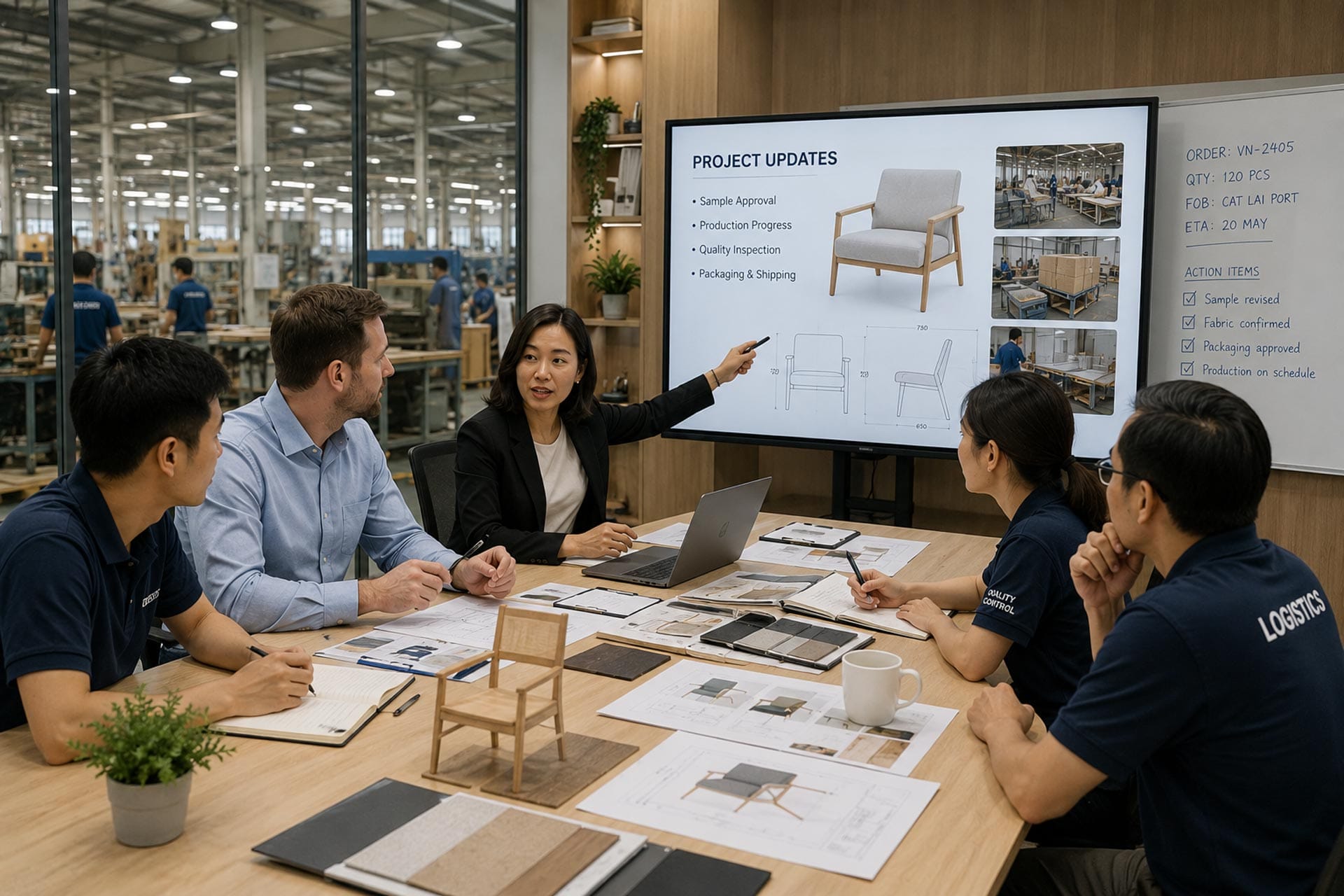
Clear communication is another critical factor international buyers look for when evaluating furniture manufacturers. Furniture production often involves technical approvals, sample revisions, production updates, packaging requirements, and shipment coordination throughout the manufacturing process.
A professional furniture factory Vietnam manufacturer must therefore maintain efficient coordination between engineering, production, quality control, and logistics teams to ensure projects move smoothly from development to final delivery.
Material Stability and Manufacturing Expertise
Material sourcing and manufacturing expertise directly affect product durability, finishing quality, and long-term production consistency. Buyers often evaluate how factories handle engineered wood, solid wood, veneers, upholstery materials, metal components, and specialty materials such as GFRC during the production process.
Experienced factories typically maintain stronger supplier relationships, better material inspection procedures, and more stable production workflows, helping reduce inconsistencies during manufacturing.
Inside a modern furniture factory Vietnam operation, the ability to work with different materials while maintaining scalability and quality standards is often a strong indicator of manufacturing maturity and operational capability.
Export Experience and Packaging Standards
Export readiness is another major consideration for global buyers sourcing furniture from Vietnam. Products must be packaged carefully to withstand long-distance transportation, international handling conditions, and varying climate environments during shipping.
Buyers often evaluate export palletization, moisture protection systems, carton reinforcement, mixed container loading capability, labeling accuracy, and shipping coordination when assessing a furniture factory Vietnam manufacturer.
Factories with strong export experience and logistics coordination are generally better equipped to support large-scale retail, hospitality, and commercial furniture programs across global markets.

The Drive Toward Sustainability
It’s clear that global consumer trends are shifting rapidly. Today, a furniture factory cannot survive long-term by simply producing beautiful or low-cost products — it must meet international sustainability standards.
As demand for eco-friendly furniture surges – especially for high-end resorts, hotels, and villas in the US, Australia, and the EU – factories that lead the way in sustainability will hold a strong, long-term competitive edge. For reputable workshops, sustainable practices have become a guiding principle rather than just an option.
At Aurora Craft, we see this not just as a trend, but as our team’s shared responsibility. That’s why we aim to build a green supply chain: every link, from sourcing materials to processing, packaging, and transport, is carefully planned to reduce our overall carbon footprint.
For example, all timber brought into our workshops carries FSC certification, ensuring it comes from responsibly managed forests. With GFRC – a lightweight, highly recyclable concrete – we continue to develop furniture lines that meet sustainability criteria while maintaining beautiful designs and long-lasting durability.
Our ultimate goal is to process every piece in a way that minimizes material waste, saves energy, and cuts down on dust and wastewater emissions released into the environment.
Conclusion
Beyond machinery, production capacity, and technical processes, what truly makes a furniture factory Vietnam manufacturer stand out is the ability to build long-term manufacturing partnerships based on consistency, flexibility, and operational reliability.
For international buyers, successful furniture manufacturing is not only about producing finished products. It also depends on clear communication, stable quality control systems, scalable production workflows, and strong export coordination throughout every stage of the project. Factories that can combine these capabilities effectively are often better positioned to support long-term collaboration across retail, hospitality, commercial, and custom furniture programs.
As Vietnam continues strengthening its role in global furniture manufacturing, experienced factories are becoming more than production facilities alone. They are evolving into strategic manufacturing partners capable of supporting global brands with reliable production, material expertise, flexible OEM and ODM capabilities, and international export readiness.
About Aurora Craft
As an experienced furniture factory Vietnam, Aurora Craft is committed to delivering products that meet global export standards. With flexible MOQ and highly competitive pricing, we are confident in providing your business with the highest quality furniture – whether for medium-sized orders or large-scale projects. Feel free to contact Aurora Craft for tailored consultation and support.
-
 Furniture Export Logistics from Vietnam: A Complete Guide for International Buyers
 -
How Lead Time Impacts Furniture Manufacturing Cost
-
 MOQ in Furniture Manufacturing: Cost Drivers Buyers Often Miss
 -
5 Best Factory Tips to Lower Custom Furniture Costs
-
Definition of MDF Wood: Properties, Types, and Applications Explained
-
How Hotel Furniture Wholesale Can Save Costs for Large Projects