

Definition of MDF Wood: Properties, Types, and Applications Explained
In this article, Aurora Craft unpacks the definition of MDF wood in detail – from its core properties, production process to different classifications and how it compares with solid wood and other engineered materials. Our goal is to give businesses a clear understanding of why this industrial board has become such a preferred choice in today’s furniture industry. Let’s dive in.
Definition of MDF Wood
MDF, or Medium-Density Fibreboard, is an engineered wood product manufactured from fine wood fibers bonded with wax and resin under high temperature and pressure. In simple terms, the definition of MDF wood refers to a dense and uniform composite panel created through this controlled industrial process.
MDF is sometimes described as being made from “wood powder,” but this is a misconception. In technical terms, MDF is composed of fine wood fibers that, due to their extremely small size, may resemble powder. This fiber-based composition is a key factor behind MDF’s smooth surface and consistent performance.
One of the most notable characteristics of MDF is its flawless, grain-free surface. Unlike natural wood, MDF contains no knots or irregular patterns, making it particularly suitable for applications that require high-quality finishes, such as painting, laminating, veneering, or precision machining.

From a historical perspective, the definition of MDF wood dates back to the 1960s, when it was first developed and quickly adopted in the furniture industry. Its ability to replicate the appearance of solid wood while offering greater consistency and cost efficiency has made it a preferred choice for modern manufacturing.
MDF Wood Properties
To fully understand the definition of MDF wood, it’s important to look at the very characteristics that make this engineered material a popular choice in today’s furniture industry. Below are the key MDF wood properties that set it apart:
Advantages
- Consistent density: Unlike solid wood, MDF has a uniform fiber density throughout the board. This ensures dimensional stability, preventing warping or shrinking over time.
- Smooth and flat surface: MDF offers a flawless, perfectly even surface. That’s why it’s the ideal material for multiple paint coats, decorative laminates, or veneers. It also makes machining and shaping easier while achieving a refined finish.
- Easy to machine: Thanks to its homogeneous structure, MDF can be cut, routed, or carved into intricate details without cracking or warping, something many other engineered woods struggle with.
- Versatile surface finishes: The board can be painted in various colors or overlaid with veneer, laminate, or decorative films, offering design flexibility and seamless integration with other interior materials.
- Cost Efficiency: Made from recycled wood fibers and production residues, MDF optimizes material usage and offers a more cost-efficient alternative to solid wood. This efficiency also contributes to more predictable production timelines in large-scale manufacturing.
In summary, MDF provides stability, versatility, and strong aesthetic performance in furniture applications. That said, like any material, it also comes with certain limitations, which we’ll explore next.
Limitations of MDF Wood
While the definition of MDF wood highlights its versatility, this material is not without its weaknesses:
- Structural limitations: MDF is inherently weaker than solid wood and may crack or split under extreme force. Its ability to hold screws and nails is also limited, as the fine wood fibers do not provide the same anchoring strength as natural timber.
- Poor moisture resistance: Poor moisture resistance: Standard MDF absorbs moisture quickly, which can lead to swelling, warping, and structural degradation, making it less suitable than some types of wood for outdoor furniture.
- Prone to staining and edge issues: Water rings from cups or condensation can leave permanent marks on its surface. Additionally, edge banding may peel off within months or years if not manufactured properly.
- Health and safety concerns: MDF is manufactured using urea-formaldehyde resins, which may release low levels of formaldehyde over time. However, products that meet standard emission regulations (such as E1 or CARB P2) are considered safe for indoor use. During machining processes such as cutting or sanding, fine dust particles may be generated, and appropriate ventilation or protective measures are recommended.
MDF Wood Production Process
The production of MDF wood panels typically goes through the following steps:
Step 1: Preparing and refining wood fibers
The process begins with carefully selected wood materials, including both hardwoods (such as oak, acacia, or eucalyptus) and softwoods (such as pine or fir). These raw materials are first debarked and chipped into small wood pieces.
The wood chips are then subjected to a defibration process, where they are softened under heat and pressure and mechanically broken down into fine, uniform wood fibers. During this stage, impurities and oversized particles are removed to ensure consistency.

The quality of the fibers at this stage plays a critical role in determining the density, surface smoothness, and machinability of the final MDF panel.
Step 2: Drying and blending
The refined wood fibers are dried to an optimal moisture content to ensure effective bonding in later stages. Proper moisture control is essential for maintaining consistent panel quality and reducing the risk of defects.
Once dried, the fibers are blended with wax and adhesive resins, most commonly urea formaldehyde. Additional additives such as hardeners, anti fungal agents, and water repellent chemicals may also be introduced to improve durability and enhance moisture resistance.
Step 3: Mat forming and hot pressing
The treated fiber mixture is first evenly distributed into a loose mat, ensuring uniform thickness and density across the panel.
This mat is then compressed under high temperature and pressure using industrial hot presses. This stage is critical, as it determines the panel’s strength, density profile, and surface smoothness. Advanced pressing technologies ensure consistent pressure distribution, resulting in flat, stable, and structurally reliable MDF boards.

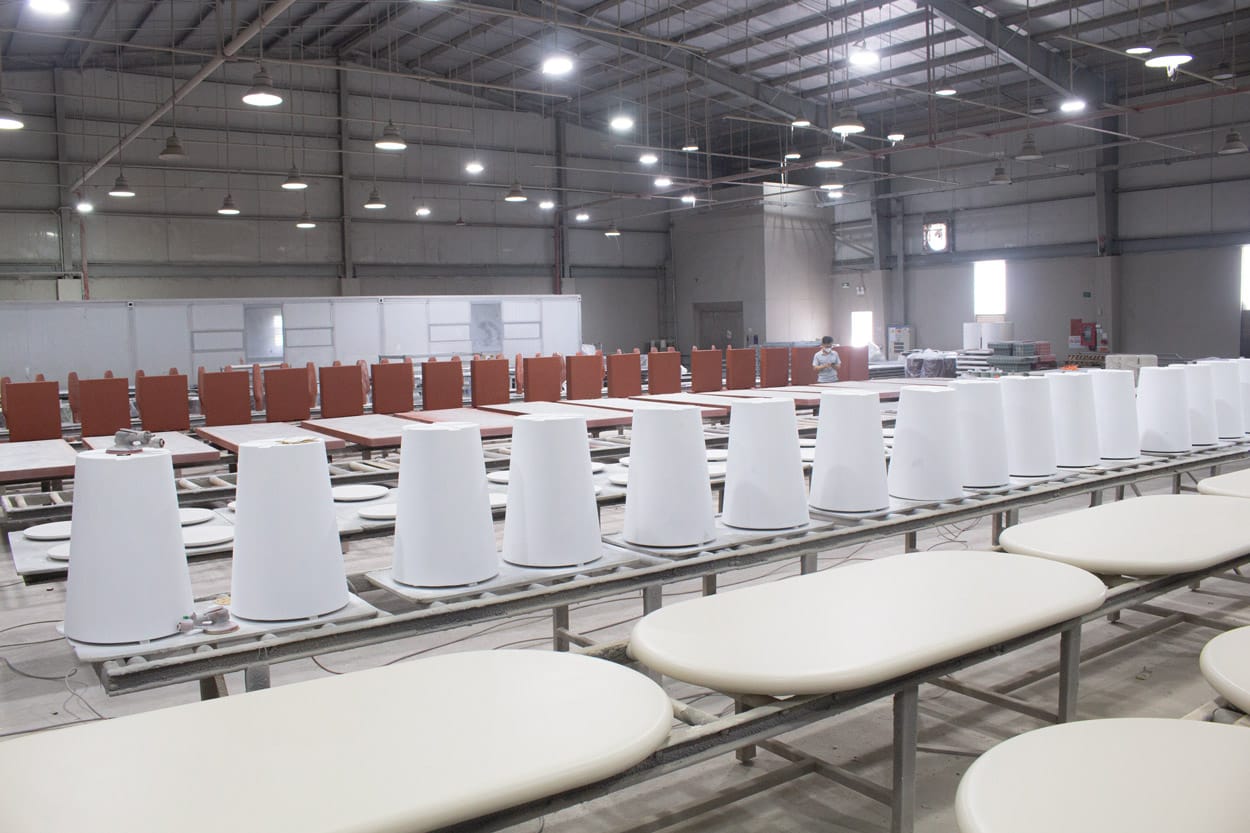
Aurora Craft also works with a wide range of furniture materials, from MDF and hardwoods to GFRC and metal, depending on each project’s manufacturing and performance requirements.
Step 4: Finishing and quality inspection
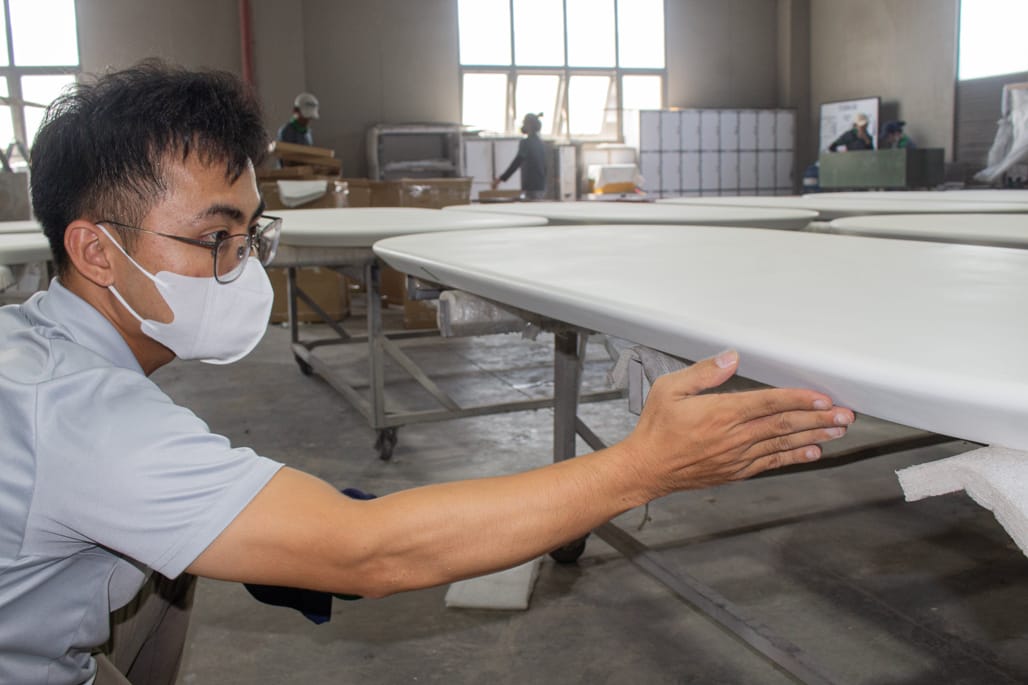
After pressing, the MDF panels are trimmed to size and sanded to achieve a smooth and even surface. Each panel undergoes quality inspection to detect defects such as warping, cracks, or surface irregularities.
Depending on production standards, additional finishing processes such as edge sealing or surface treatments may be applied to improve durability, enhance appearance, and optimize performance in end use applications.
Common Types of MDF Wood in Vietnam: Understanding the Definition of MDF Wood in Practice
In the Vietnam furniture industry, the definition of MDF wood goes beyond its basic composition and also reflects how the material is adapted for different environments. In practice, MDF is commonly classified into three main types based on its performance characteristics: standard MDF, moisture-resistant MDF, and fire-retardant MDF:
- Standard MDF: Standard MDF represents the most common application of the definition of MDF wood. It is a cost effective engineered panel with a uniform fiber structure, smooth surface, and excellent machinability, widely used in interior furniture for dry environments. However, its resistance to moisture is limited, and prolonged exposure to humidity may cause swelling or deformation, making it more suitable for living rooms, bedrooms, and decorative applications.
- Moisture-Resistant MDF (MR MDF/Green Core MDF): Moisture resistant MDF builds upon the basic definition of MDF wood by incorporating wax emulsions and enhanced resin systems to reduce water absorption and improve dimensional stability. It is suitable for humid environments such as kitchens and bathrooms, maintaining similar strength and workability to standard MDF while offering improved performance in damp conditions.
- Fire-Retardant MDF (FR MDF): Fire retardant MDF is another specialized variation derived from the definition of MDF wood, engineered with additives that enhance fire resistance and slow flame spread. It is commonly used in commercial interiors where fire safety regulations are required, such as offices, hotels, and public buildings, and due to its specialized formulation, it typically comes at a higher cost.
Quick Comparison
| Feature | Standard MDF | Moisture-Resistant MDF | Fire-Retardant MDF |
| Price | Most affordable | Moderate | Highest |
| Moisture Resistance | Low | Improved | Moderate |
| Fire Resistance | Low | Low | High |
| Applications | Dry indoor furniture | Kitchens, bathrooms | Commercial interiors |
Applications of MDF Wood in Furniture Production
Based on the definition of MDF wood as a smooth, uniform, and engineered material, MDF is widely used across a variety of furniture and interior applications due to its versatility and consistent performance.
In residential and commercial furniture production, MDF is commonly applied in cabinetry and storage units such as kitchen cabinets, wardrobes, and shelving systems, where a smooth surface is required for painting, laminating, or veneering. It is also widely used for decorative interior elements, including wall panels, partitions, and ceiling features, thanks to its ability to support intricate designs and uniform finishes.

Additionally, MDF is suitable for interior doors, moldings, and architectural components, providing dimensional stability and a reliable base for coatings. In commercial settings, it is often used in office furniture, workstations, and retail displays, where cost efficiency and consistent quality are essential for large-scale production.

Moreover, due to its homogeneous fiber structure, MDF is an ideal material for CNC machining and custom furniture designs, allowing precise cutting, carving, and detailing without cracking or splintering. In practice, these designs can be developed through different production models depending on business needs.
Comparing MDF with Other Wood Materials
To better understand the definition of MDF wood in a practical and convincing way, it is necessary to compare it with other types of wood. Cost is also a critical factor when choosing materials, especially in international sourcing and manufacturing.
| Criteria | MDF | Solid Wood | HDF | Particle Board (PB/MFC) |
| Strength | Medium | Very high | High | Low |
| Moisture | Low | Medium | Medium | Very low |
| Workability | Easy | Hard | Hard | Easy |
| Surface | Smooth | Natural grain | Smooth | Rough |
| Cost | Medium | High | High | Low |
| Best Use | Furniture, panels | Premium furniture | Flooring, doors | Budget furniture |
| Choose when | Smooth finish, CNC, cost balance | Strength, durability, natural look | High density, impact resistance | Low cost, simple use |

Conclution
Understanding the definition of MDF wood helps businesses make more informed material choices in furniture production. As an engineered wood made from compressed fibers, MDF offers a balanced combination of smooth surface quality, consistent performance, and cost efficiency, making it a preferred option for many interior applications. While each material, including solid wood, HDF, and particle board, has its own advantages, MDF stands out for its versatility and scalability. Ultimately, selecting the right material depends on the specific requirements of the project, but choosing the right manufacturing partner is equally important for long-term success alongside environment, budget, and performance expectations.
With over 15 years of expertise in furniture manufacturing, Aurora Craft is a trusted partner for global businesses. We deliver complete furniture solutions, from MDF and HDF to premium materials, ensuring outstanding quality, durability, and aesthetics. Get in touch with Aurora Craft today to bring your professional, cohesive, and elegant interior projects to life.
-
 How Lead Time Impacts Furniture Manufacturing Cost
 -
 MOQ in Furniture Manufacturing: Cost Drivers Buyers Often Miss
 -
5 Best Factory Tips to Lower Custom Furniture Costs
-
Definition of MDF Wood: Properties, Types, and Applications Explained
-
How Hotel Furniture Wholesale Can Save Costs for Large Projects
-
Guide to Furniture for Retailers: Select the Right Materials for Your Business


