
5 Best Factory Tips to Lower Custom Furniture Costs
Are you looking for smarter ways to optimize your custom furniture costs but not sure where to begin? Let Aurora Craft guide the way. With more than 15 years of experience working alongside international partners, Aurora Craft has gained valuable hands-on insight into how businesses can achieve better cost efficiency without compromising product quality. Below are 5 key insights we have learned from real-world production experience, and we hope they will help your business make more strategic and cost-effective sourcing decisions.
Larger Order Volumes Can Significantly Reduce Unit Costs
Order quantity is one of the most important factors affecting custom furniture costs. In real manufacturing environments, the same product almost always becomes more cost-efficient and helps reduce custom furniture costs when produced in larger volumes. A 2,000-unit order, for example, will typically have a much lower per-unit cost than an order of just 50 units.
So, where does this difference come from? The answer lies in the initial setup investment. These are fixed costs that exist regardless of order size, including machine setup, mold creation, production programming, prototype testing, and workflow calibration. Whether a factory produces 50 units or 2,000 units, these preparation costs still need to happen. The difference is that larger production runs allow those costs to be distributed across many more products, significantly lowering the cost per unit.
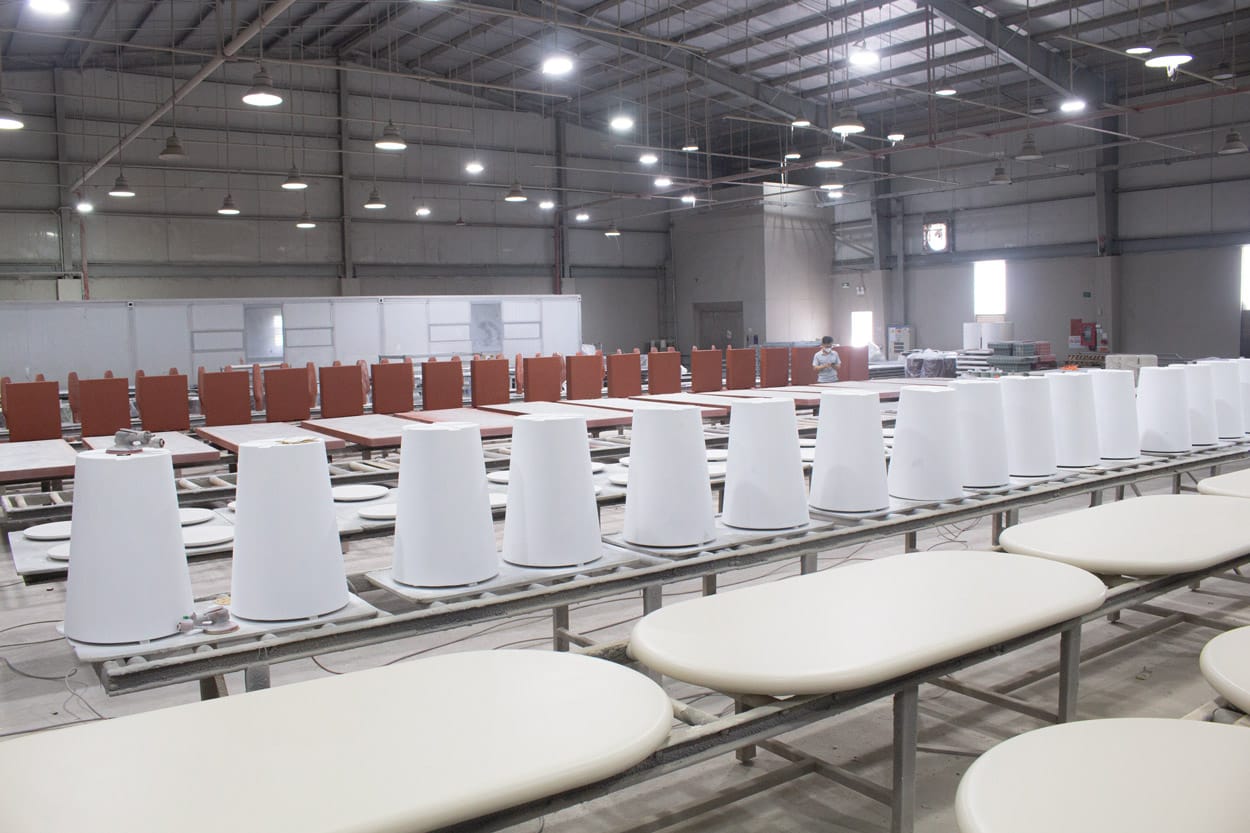
For example, Aurora Craft recently handled two GFRC dining table production projects. One order consisted of 50 sets, while the other involved 2,000 sets. Even though both projects used the same material and production process, the estimated cost structure showed a clear gap in efficiency.
| Estimated Input | 50-Set Order | 2,000-Set Order |
| Production Material | GFRC (Glass Fiber Reinforced Concrete) | |
| Initial Setup Investment | $250 | |
| Production Cost Per Unit | $5.00/unit (setup cost distributed across 50 units) | $0.125/unit (setup cost distributed across 2,000 units) |
| Estimated Production Time Per Unit | ~10 minutes | ~7 minutes |
| Material Cost Per Unit | $6.35 | $6.10 |
| Estimated Scrap Rate | ~3% | ~1 – 1.5% |
| Total Estimated Cost Per Unit | ~$11.80 | ~$9.10 |
As the table shows, increasing production volume reduced the per-unit manufacturing cost by approximately 20 – 25%, even though the product design and materials remained identical. In the B2B furniture industry, that reduction in custom furniture costs can create a significant competitive advantage.
At larger production scales, Aurora Craft is also able to optimize the entire workflow more effectively. From cutting and fabrication to finishing and packaging, the production line can run continuously without frequent interruptions. Machines spend less time idle, and workers do not need to constantly switch between different tasks. As a result, downtime and production errors are significantly reduced.
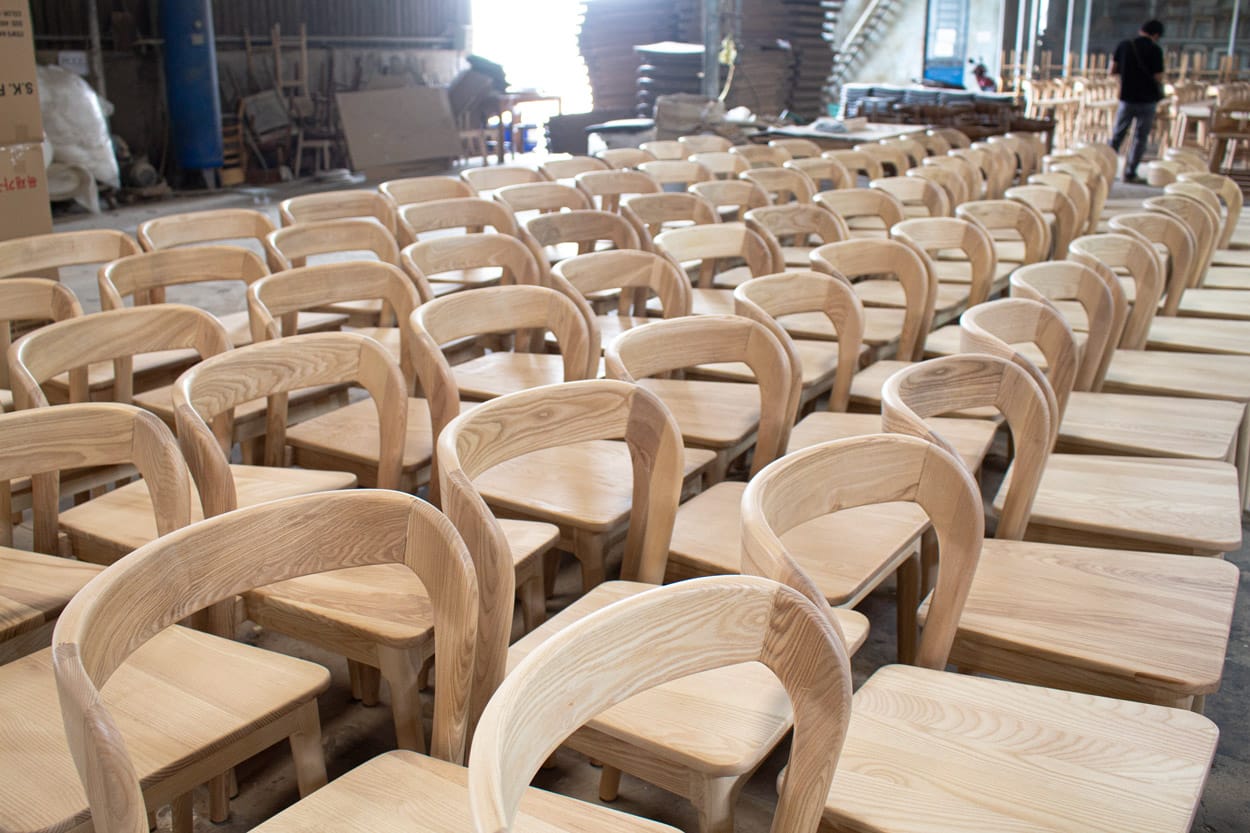
This is why larger production orders do not simply lower costs. They also help stabilize quality consistency across the entire batch.
When consulting international partners, our team always encourages businesses to evaluate production volume strategically and build a clear sourcing plan from the beginning. In many cases, thoughtful planning is one of the most effective ways to gain better control over custom furniture costs while maintaining long-term production efficiency.
Choosing Materials Strategically Can Greatly Optimize Custom Furniture Costs
In furniture manufacturing, raw materials are often the fastest way for costs to spiral out of control when not managed carefully. One poor material decision alone can significantly disrupt the custom furniture costs a business originally planned for.
A classic example is teak wood – a premium material widely used in outdoor furniture because of its natural resistance to water, humidity, and harsh weather conditions. However, those advantages come with a considerably higher price tag. In the international timber market, teak can cost two to three times more than commonly used woods such as acacia or eucalyptus.
The real question, however, is this: does every product truly need the “maximum performance” that solid teak offers?
For covered outdoor areas, semi-outdoor hospitality projects, or products designed for moderate-use environments, using 100% solid teak may not always be the most balanced investment. In some cases, it can even become an unnecessary cost burden compared to the product’s actual functional requirements.
| Wood Type | Estimated Price (USD/m³) | Primary Applications |
| Teak | $900 – $1,500 | Water-resistant, weather-resistant, ideal for premium outdoor furniture |
| Acacia | $350 – $600 | Durable, cost-efficient, suitable for indoor & semi-outdoor use |
| Eucalyptus | $300 – $500 | Lightweight, easy to process, commonly used for mass-market furniture |
| (*)Note: Material prices in the furniture industry fluctuate depending on grade, sourcing region, and market conditions. The figures above are compiled from international market references such as ITTO, Global Wood data, and Aurora Craft’s export manufacturing experience. | ||
At Aurora Craft, our team does not approach materials with the mindset of “the more premium, the better.” Instead, we focus on selecting materials that align with the project’s actual usage, target market, and investment strategy.
Because in many real-world projects, materials that exceed practical requirements rarely create proportional value. They simply push custom furniture costs higher.
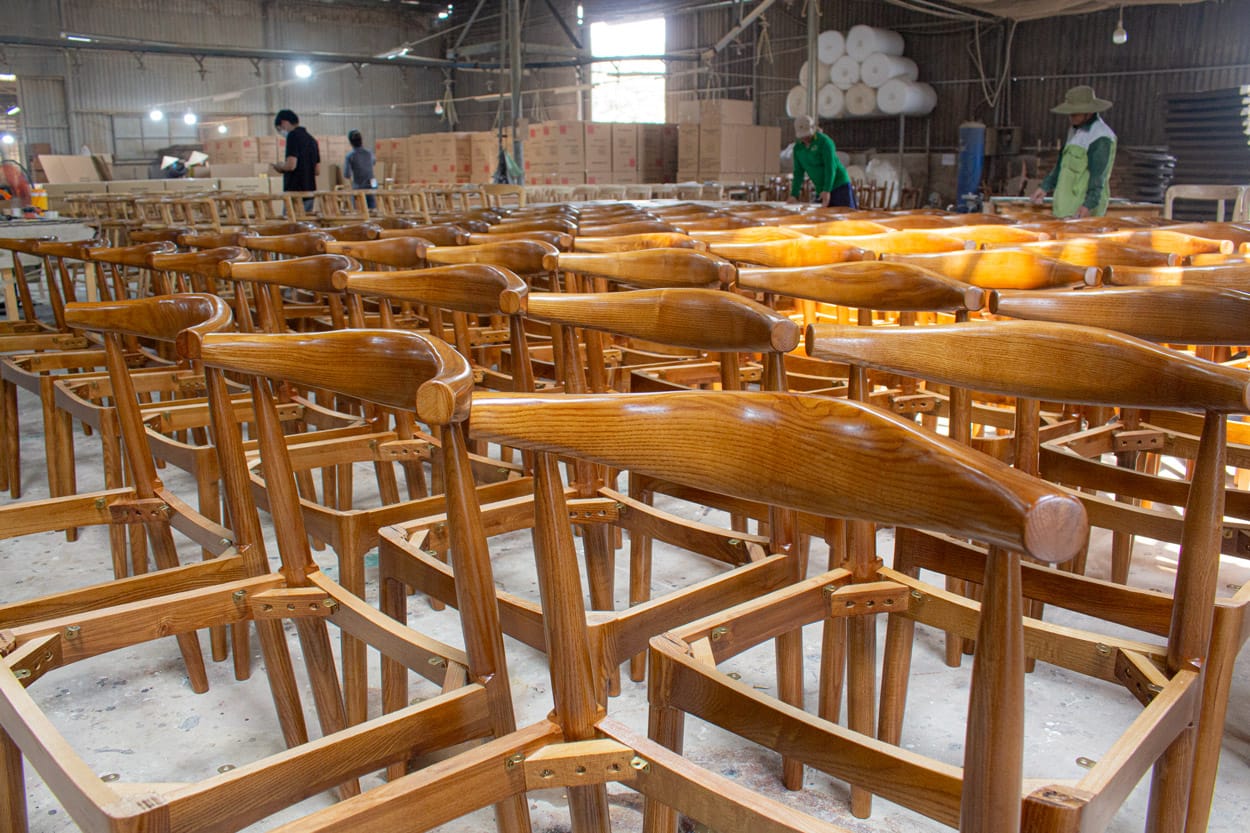
For mid-range to high-end projects, Aurora Craft’s engineering team often recommends more strategic material combinations. Instead of using 100% solid teak – which comes with substantial raw material costs — businesses can adopt a hybrid structure using moisture-resistant marine plywood or engineered wood cores such as MDF, HDF, or LVL, then finish the surface with genuine teak veneer.
This approach allows the product to maintain the luxurious appearance and authentic texture of real teak, while optimizing the internal structure for better cost efficiency and dimensional stability.
To better illustrate the difference, below is a comparison between two material solutions for the same 50-set dining furniture order.
| Criteria | 100% Solid Teak | Teak Veneer + Marine Plywood Core |
| Raw Material Cost | ~$180 – $220/set | – Teak veneer: ~$40 – $60 – Marine plywood core: ~$80 – $100 → Total: ~$120 – $160/set |
| Labor Cost (Reference) | ~$12 – $14/hour (solid wood processing with more manual craftsmanship) | ~$8 – $10/hour (panel-based production with easier standardization) |
| Manufacturing Complexity | Moderate (solid wood processing with fewer layers) | Higher (veneering, lamination, surface treatment) |
| Production Workflow Efficiency | More labor-intensive | More standardized batch processing |
| Aesthetic Quality | Premium appearance with natural wood grain consistency | Very close to solid teak due to genuine teak veneer surface |
| Outdoor Durability | Excellent (full outdoor use) | High (ideal for indoor and semi-outdoor projects) |
| Estimated Cost Per Unit | ~$340 | ~$270 |
As the comparison shows, simply adjusting the internal material structure can help businesses save approximately 10–15% in production expenses. This is the essence of smart furniture production cost optimization, not cutting corners, but making better strategic decisions.
That is why, when searching for partners specializing in furniture manufacturing in Vietnam, businesses should prioritize factories with real-world production experience. A capable manufacturing partner should understand how and where the product will actually be used, then recommend material solutions that balance performance, aesthetics, and budget.
At Aurora Craft, we believe competitive advantage does not come from choosing the cheapest material. It comes from choosing the right material for the right product, the right market, and the right long-term business strategy.
Optimizing SKU Quantity – A Cost Factor Many Businesses Overlook
In manufacturing, there is one concept that seems simple on the surface, yet has a direct impact on custom furniture costs: SKU (Stock Keeping Unit).
Put simply, an SKU represents each unique version of a product. Even a small change in color, dimensions, materials, or finishing details can turn one product into an entirely different SKU from a manufacturing perspective.
For example, imagine the same chair design offered in multiple variations:
- Black chair → 1 SKU
- White chair → 1 SKU
- Black chair with leather cushion → another SKU
- Black chair with fabric cushion → yet another SKU
=> In other words, even when the core design remains identical, small specification changes can quickly multiply the number of SKUs a factory must handle. And this is where production complexity & cost quietly begin to rise.
Let’s compare two production scenarios:
1 SKU × 2,000 units & 5 SKUs × 400 units each
Technically, the total production volume remains the same at 2,000 units. However, the way the factory operates behind the scenes becomes completely different.
| 1 SKU × 2,000 Units | 5 SKUs × 400 Units Each |
| Production line runs continuously and smoothly, like a straight flow | Production is divided into multiple interruptions due to SKU switching |
| Minimal setup adjustments required | Machines and workflows must be reset after each SKU change |
| Higher machine and labor efficiency | Efficiency drops due to increased downtime |
| Lower defect rates thanks to process stability | Higher error risk during transition stages |
| Easier to maintain consistent product quality | Harder to ensure consistency across smaller batches |
| Better optimization of custom furniture costs | Increased hidden manufacturing costs |
In manufacturing, these interruptions are known as changeover costs. When SKU switching happens frequently, changeover-related activities can account for approximately 5–10% of total operational costs.
But the impact goes beyond cost alone. Constant SKU changes also increase the likelihood of production errors. Transition phases are often when machinery, workflows, and operators are least stable. This can lead to material waste, inconsistencies, or even product rework – all of which quietly erode profitability over time.
From Aurora Craft’s real-world manufacturing experience, the solution is not necessarily to reduce SKU quantity altogether. The real challenge is learning how to manage SKUs intelligently.
One of the most effective strategies we often recommend is modular product design. In this approach, the core structure or frame remains standardized, while surface-level elements, such as: colors, upholstery materials, or accessories… can still be customized.
This allows businesses to maintain product diversity for different markets without constantly disrupting the production line. The result is a healthier balance between flexibility and operational efficiency, while keeping custom furniture costs under control in a far more sustainable way.
Flexible Production Scheduling and Delivery Planning Can Significantly Reduce Costs
Furniture manufacturing operates like a continuous production flow, and time is what determines the rhythm of that flow. In real-world factory operations, the more aggressively production timelines are compressed, the more manufacturing costs tend to increase.
Rush orders, for example, often force factories to disrupt their original production plans. Workers may need to operate overtime, production priorities must be rearranged, and resources are often redirected toward a single urgent order. While these adjustments may help meet tight deadlines, they also reduce the overall efficiency of the production system. In many cases, this can increase manufacturing costs by approximately 7% or more.
On the other hand, when production timelines are more flexible, factories gain the ability to optimize operations strategically. One common approach is “mixed-order production”, combining multiple orders with similar materials, structures, or manufacturing processes into the same production cycle.
This method closely aligns with the principles of heijunka (production leveling) in lean manufacturing. Instead of forcing the factory to constantly accelerate and slow down, the production line maintains a more stable and balanced workflow. Machines run more consistently, labor efficiency improves, and operational capacity can be utilized more effectively.

At Aurora Craft, this is one of the key strategies our team applies to optimize custom furniture costs for international clients.
For example, a standalone order of 300 units may need to absorb the full setup and operational costs on its own. However, by strategically combining that order with other projects sharing similar technical requirements or materials, our production team can keep the manufacturing line running continuously. This reduces downtime, minimizes production errors, and significantly lowers the cost per unit.
From Aurora Craft’s perspective, lead time should not be viewed simply as a delivery deadline. When managed strategically, it becomes a powerful tool for improving operational efficiency and achieving smarter long-term cost control.
Long-Term Partnerships Are the Key to Optimizing Custom Furniture Costs
After more than 15 years of working alongside international partners, Aurora Craft has learned one important truth: custom furniture costs are not determined by individual orders alone. In many cases, they are shaped just as much by the quality of the relationship between the business and the factory itself.
That is why supplier manufacturer collaboration should never be viewed as a short-term transaction. It should be treated as a long-term operational strategy.
When a relationship is built solely around “quotation and purchase orders,” every new project essentially starts from zero. Raw materials are purchased reactively based on market fluctuations at that moment. Production planning becomes fragmented. Labor allocation is harder to optimize, and manufacturing efficiency often suffers as a result.
The dynamic changes completely when both sides commit to working together over the long term. Once a factory understands a client’s production roadmap for the next three months, six months, or even a full year, the entire operational structure becomes more strategic and stable.
Materials no longer need to be sourced under urgent conditions. Instead, purchasing teams can negotiate larger-volume procurement at more competitive pricing. Production lines no longer operate in isolated bursts for small orders, but are scheduled according to a more efficient manufacturing rhythm. Labor and machinery can also be allocated more consistently, minimizing costly idle periods across the factory floor.
And when those operational improvements begin to align, custom furniture costs can be optimized across the entire supply chain:
- Up to 16% reduction in procurement-related costs
- Up to 26% improvement in on-time delivery performance
- Approximately 4% improvement in product quality consistency
- Around 8% improvement in total operational cost efficiency
At Aurora Craft, we do not simply wait for orders to arrive. Our team actively works alongside clients to build long-term production strategies.
For partners planning on a quarterly or annual basis, Aurora Craft often proposes solutions such as consolidated production cycles, advance material purchasing, or partial product standardization to improve manufacturing efficiency. This approach not only helps control custom furniture costs more effectively, but also creates greater pricing stability in an increasingly volatile global market.
Today, Aurora Craft continues to serve as a trusted manufacturing partner for businesses and retailers across international markets. As one of Vietnam’s experienced furniture manufacturers, our team proudly supplies a wide range of high-quality furniture products tailored to global export standards.
If your business is searching for a reliable long-term manufacturing partner, Aurora Craft is ready to help you build a smarter, more sustainable production strategy for the years ahead. Contact Aurora Craft today to explore the right manufacturing solution for your next project.


-
 Furniture Export Logistics from Vietnam: A Complete Guide for International Buyers
 -
How Lead Time Impacts Furniture Manufacturing Cost
-
 MOQ in Furniture Manufacturing: Cost Drivers Buyers Often Miss
 -
5 Best Factory Tips to Lower Custom Furniture Costs
-
Definition of MDF Wood: Properties, Types, and Applications Explained
-
How Hotel Furniture Wholesale Can Save Costs for Large Projects